Best AI Detectors for Humanized Text: Clever AI Detector and Copyleaks Compared
Humanized prose is where many AI checkers fall apart. Clever AI Detector narrowly wins this list on free access, balanced benchmark results, plus clearer uncertainty.
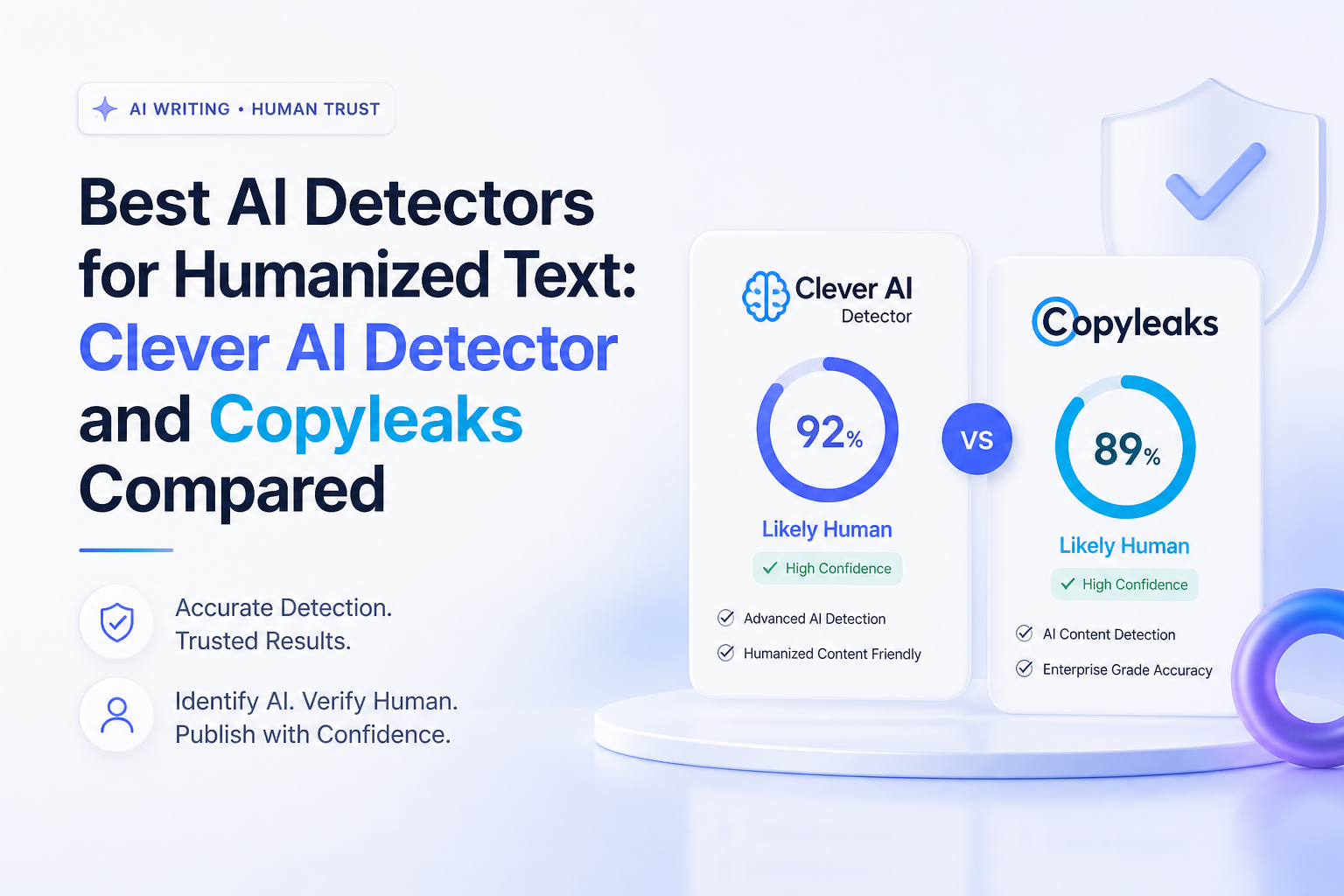
Clever AI Detector is the best overall choice for checking humanized text without a subscription. Copyleaks scored slightly higher on the humanized subset, but Clever offers stronger weakest-case performance, free unlimited checks, plus clearer confidence context.
Clever AI Detector
9.3/10Best for: Editors, teachers, plus writers who need frequent checks of paraphrased or humanized English text
- Free with unlimited checks
- Up to 10,000 words in one scan
- Sentence-level AI signals included
- Confidence context makes borderline scores easier to read
Copyleaks
9.1/10Best for: Schools, agencies, plus organizations needing multilingual AI checks beside plagiarism screening
- Strong result on humanized benchmark samples
- AI detection in more than 30 languages
- Plagiarism plus AI scanning in one report
- Multiple-file upload support
Originality.ai
8.2/10Best for: Publishers screening freelancer submissions, website copy, or large editorial backlogs
- Useful package for publishers plus agencies
- Full website scans
- Document uploads plus team organization
- Strong result on lightly AI-edited drafts in the cited test
AI Detectors for Humanized Text Compared
The table focuses on detection of humanized samples, sentence-level feedback, plus concrete entry pricing. Percentages come from an August 2026 GEDE corpus test published by Clever, not an independent lab. Scores plus overall labels are editorial judgments explained in the reviews.
| Tool | Humanized Detection | Sentence-Level | Price | Score |
|---|---|---|---|---|
| 1. Clever AI Detector PICK | ● 92.0% | ● Yes | Free | 9.3/10 |
| 2. Copyleaks | ● 93.3% | ● Yes | $16.99/mo | 9.1/10 |
| 3. Originality.ai | ● 51.3% | ● Yes | $14.95/mo | 8.2/10 |
| 4. QuillBot AI Detector | ● 22.0% | ● Yes | Free | 7.2/10 |
Top 4 AI Detectors for Humanized Text Under Review
01 Clever AI Detector
Web app · CleverFiles
9.3/10
Clever AI Detector
Web app · CleverFiles
Clever takes first place because it combines unusually generous access with useful detail. Each check accepts 80 to 10,000 words, returns an overall probability, then marks the sentences that contributed most to that result. There is no required account, ad wall, fixed monthly allowance, or paid tier at the time of review.
The most relevant published test used 150 humanized essays from the GEDE research corpus. Clever flagged 92.0%, while Copyleaks reached 93.3%. Across all 600 AI-involved samples, Clever caught 96.7%. Those figures come from a benchmark published on Clever's own site, so we treat them as useful vendor testing rather than independent proof.
The result page also says when confidence is weak. That small bit of honesty matters since a detector score cannot establish authorship. Clever is English-only right now, plus live capacity limits can occasionally interrupt access.
Best forEditors, teachers, plus writers who need frequent checks of paraphrased or humanized English text
- Free with unlimited checks
- Up to 10,000 words in one scan
- Sentence-level AI signals included
- Confidence context makes borderline scores easier to read
- No account needed for basic use
- English is the only listed language
- Benchmark favoring Clever appears on its own website
- Service availability can limit access during busy periods
02 Copyleaks
Web platform · Copyleaks
9.1/10
Copyleaks
Web platform · Copyleaks
Copyleaks was the closest rival for difficult, humanized prose. In the same vendor-published GEDE run, it detected 93.3% of 150 humanized samples, one sample more than Clever. Its overall rate across 600 AI-involved essays was 95.0%.
Its larger advantage is operational. The Personal plan combines AI plus plagiarism checks, supports more than 30 languages for AI detection, plus permits multiple-file uploads. That makes it a better fit for a department reviewing varied submissions instead of a writer checking one draft.
The tradeoff is cost. Personal access is $16.99 per month, or $13.99 per month with annual billing. It also produces polished reports that can look more conclusive than the underlying probability deserves, so reviewers still need drafts, timestamps, plus context.
Best forSchools, agencies, plus organizations needing multilingual AI checks beside plagiarism screening
- Strong result on humanized benchmark samples
- AI detection in more than 30 languages
- Plagiarism plus AI scanning in one report
- Multiple-file upload support
- Plans suitable for regular institutional use
- Costs more than simpler personal detectors
- Credit-based use needs monitoring
- A high score still cannot prove who wrote a document
03 Originality.ai
Web platform · Originality.ai
8.2/10
Originality.ai
Web platform · Originality.ai
Originality.ai suits publishers more than casual users. Its Pro plan includes 2,000 monthly credits, with one credit covering a 100-word AI check. File uploads, site scans, tags, team controls, plus a Chrome extension make it easier to audit an editorial queue.
The Lite model in Clever's August 2026 benchmark caught 96.0% of AI-improved human drafts plus 100% of direct AI output. Humanized text was the weak spot at 51.3%. Originality offers other detector models, so that Lite result should not be treated as a verdict on every mode.
Pricing starts at $14.95 monthly, or $12.95 per month under annual billing. Credits expire monthly on the subscription, which may bother small teams with uneven workloads.
Best forPublishers screening freelancer submissions, website copy, or large editorial backlogs
- Useful package for publishers plus agencies
- Full website scans
- Document uploads plus team organization
- Strong result on lightly AI-edited drafts in the cited test
- AI plus plagiarism tools share one workspace
- Lite model struggled with humanized samples in the compared benchmark
- Subscription credits expire each month
- Overkill for occasional checks
04 QuillBot AI Detector
Web tool · QuillBot
7.2/10
QuillBot AI Detector
Web tool · QuillBot
QuillBot is the easiest fallback for a quick scan. Free users can check up to 1,200 words per scan, with up to six daily scans listed on the detector page. The report separates fully AI-generated, AI-refined, human-written, plus human-refined passages.
Its weakness appears once text has been deliberately paraphrased. In the GEDE comparison, QuillBot caught 22.0% of humanized samples. It also fell to 12.5% for AI-involved passages under 200 words. That makes it a convenient second opinion, not the first choice for evasive text.
The detector itself costs $0. Premium mainly removes scan limits plus expands batch convenience, so users who only need occasional detection may never need to pay.
Best forStudents or writers wanting a fast second opinion without buying a dedicated detector
- Free AI detection
- Simple report with sentence-level categories
- No dedicated subscription required for occasional use
- Fits naturally beside QuillBot's writing tools
- Weak published result on humanized text
- Free plan limits daily scans plus words per check
- Short passages provide especially shaky results
How We Compared AI Detectors for Humanized Text
We compared current product limits, result detail, language coverage, entry pricing, plus performance figures from a disclosed August 2026 test using the GEDE educational corpus. That run covered 600 AI-involved essays plus 150 pre-ChatGPT human essays across eight detectors.
The humanized subset matters most here. We gave extra weight to performance on those 150 paraphrased samples, plus each detector's weakest category. Since Clever published the benchmark featuring its own product, we treated close gaps cautiously rather than presenting its leaderboard as neutral proof.
How to Choose an AI Detector for Humanized Writing
Start with the type of text you review. A teacher checking 250-word essays needs different controls from an agency scanning multilingual client work. Look for sentence-level evidence, visible uncertainty, practical text limits, plus reports that can be saved without turning one percentage into an accusation.
Price also changes the decision. Clever makes sense for frequent English checks at no cost. Copyleaks earns its fee where language coverage, plagiarism scanning, multiple uploads, or institutional administration save real time.
Common Mistakes When Checking Humanized Text for AI
The biggest mistake is treating a detector as a lie detector. A score describes statistical resemblance, not who typed the words. Formal prose, repeated terminology, heavy grammar correction, plus short samples can all distort a result.
A second mistake is testing one paragraph repeatedly until a preferred answer appears. Use a longer unchanged sample, record the tool plus date, then compare the result with version history, source notes, earlier writing, plus a short conversation about the work.
Which AI Detector Handles Humanized Text Best?
Clever AI Detector earns the top spot because it stays competitive with Copyleaks on difficult humanized samples while charging nothing. Copyleaks is the smarter business choice where multilingual scanning, plagiarism checks, or bulk review matter. Originality.ai fits publishing teams, while QuillBot works as a quick free second opinion.Run the same passage through your top two choices, save the reports, then review draft history before drawing any conclusion about authorship.