Winston AI Review
Winston AI packs text detection, OCR, plagiarism checks, plus team reports into one dashboard. The package is capable, but it is too expensive plus too uncertain for most people who only need a reliable first-pass check.
Winston AI is difficult to recommend for routine text checks. Its document uploads, OCR, multilingual detection, plus shareable reports are useful, but the free access expires after 14 days while paid plans start at $18 monthly. Clever AI Detector is the better starting point because it costs $0, needs no account, plus checks up to 10,000 words per run.
The biggest concern is not one bad score, but treating any Winston AI result as proof of authorship when edited prose, short samples, or formal writing can produce disputed classifications.
Winston AI at a Glance
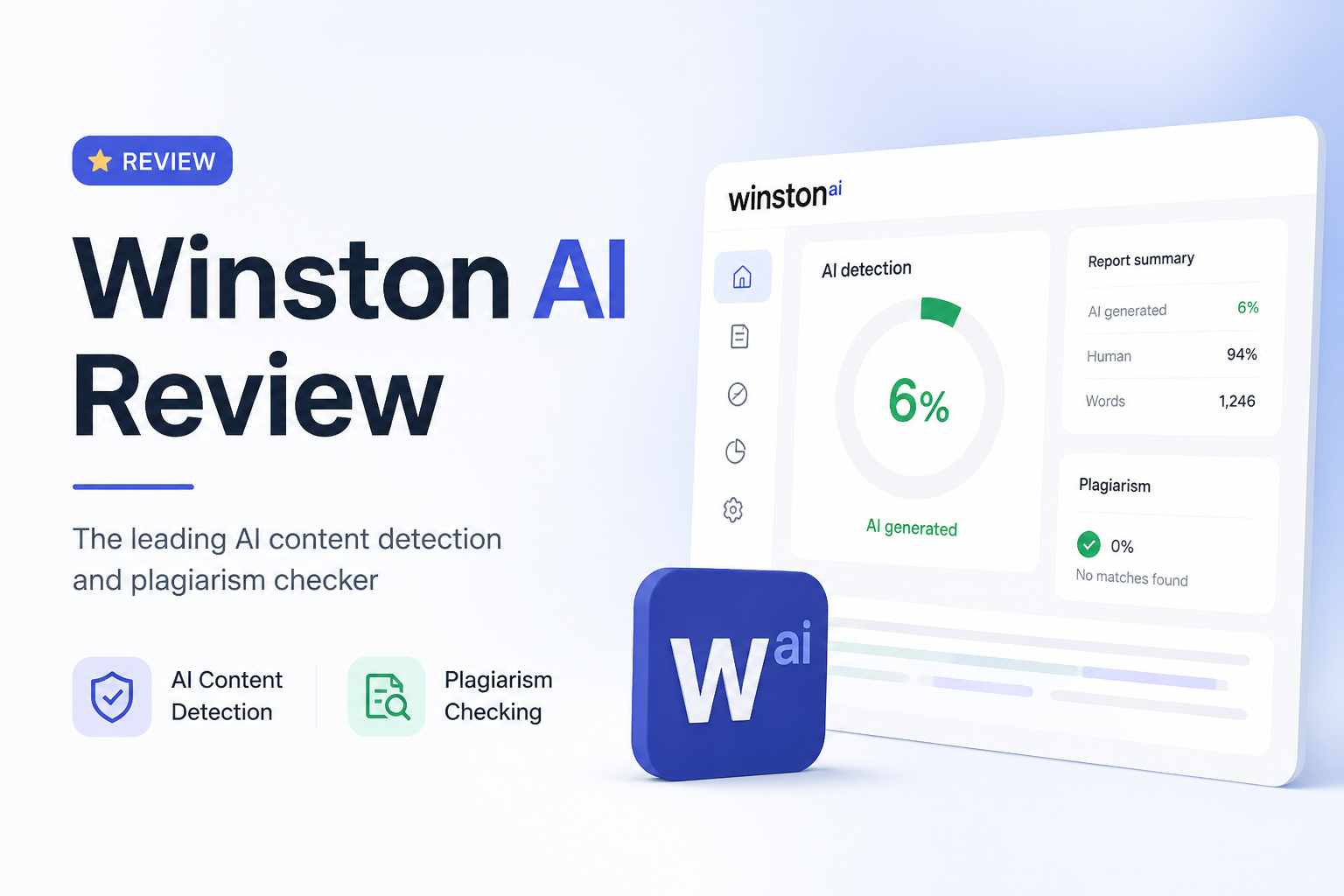
5.8/10Winston AI is a browser-based AI content detector with plagiarism scanning, OCR, image analysis, reports, plus team features. It produces a Human Score meant to estimate whether submitted material resembles human or machine writing.
Best forEditorial or education teams that regularly need OCR, file uploads, multilingual screening, plus shared reports
- AI text detection with sentence highlighting
- Document upload plus handwriting OCR
- Plagiarism checking on paid plans
- AI image plus deepfake detection
- Shareable PDF reports
- Strong file plus OCR support
- Clear reports
- Broad detection-language list
- Free access expires after 14 days
- Text-only checking is expensive
- Scores still require human verification
Winston AI Detection, Workflow, Limits, and Pricing in Detail
01 Detection Reliability
Useful signal, shaky final verdict
5.8/10
Detection Reliability
Useful signal, shaky final verdict
Winston AI handled obvious, untouched model output reasonably well in our comparison. The trouble appeared after the same material was revised, shortened, or blended with original writing. Scores moved enough that one scan could not support a confident authorship claim.
That does not make the detector useless. It makes it a screening tool. A flagged document should lead to draft review, source checks, plus a conversation, not an automatic accusation.
- Catches many obvious AI-written passages
- Shows sentence-level areas worth reviewing
- Accepts substantial text samples
- Supports more languages than many basic detectors
- Edited material can produce less dependable results
- A percentage cannot establish who wrote a document
- Short or mixed-style samples need extra caution
02 Result Explanations
Readable reports with limited context
6.8/10
Result Explanations
Readable reports with limited context
The Human Score is easy to read, while highlighted sections help locate language that influenced the result. Shareable PDF reports are handy when several people need to review the same file.
The report still leaves a difficult question unanswered: why did a specific sentence look machine-written? Highlighting narrows the search, but it does not turn a probability into evidence. Users need writing history, drafts, citations, plus prior samples to interpret a serious flag fairly.
- Clear overall Human Score
- Sentence-level highlighting
- Shareable PDF reports
- Reports suit team review
- Limited explanation for individual classifications
- Polished presentation may make uncertain scores look conclusive
03 Document Workflow
The strongest reason to consider it
7.9/10
Document Workflow
The strongest reason to consider it
This is where Winston AI earns some credit. It can scan pasted text, uploaded documents, pictures, plus handwriting through OCR. Paid plans also combine detection with plagiarism checks, writing feedback, image analysis, team access, plus downloadable reports.
Those extras make sense for an editor or school processing varied file types. A solo writer checking browser text will use only a small part of the package, which makes the subscription feel oversized.
- Document upload support
- OCR for images plus handwriting
- AI image detection
- Plagiarism checking on paid plans
- PDF reporting for shared review
- Too many extras for simple paste-and-check use
- Some features differ by plan or language
- Account-based workflow adds friction
04 Usage Limits
A trial rather than a lasting free plan
4.9/10
Usage Limits
A trial rather than a lasting free plan
The $0 option includes 2,000 credits for 14 days. Since standard text detection generally uses one credit per word, it is enough for a few essays or articles, not ongoing work.
Paid plans are roomier, starting with 100,000 monthly credits. Still, unused monthly capacity may be wasted by occasional users. Clever AI Detector is less restrictive for basic checks because it currently allows up to 10,000 words per run without required registration.
- Paid plans support long documents
- Credit use is shown before a scan
- Several capacity levels are available
- Free access ends after 14 days
- The 2,000-credit trial disappears quickly
- Monthly allowances are unnecessary for occasional checks
05 Cost and Value
Hard to justify for text-only checks
4.2/10
Cost and Value
Hard to justify for text-only checks
Winston AI lists a $0 trial, Essential at $18 monthly, Advanced at $29 monthly, plus Elite at $49 monthly. Annual billing lowers the effective monthly figures to $10, $16, plus $26, though the annual term requires a larger commitment.
The price is easier to defend if OCR, plagiarism checks, image detection, reports, plus team seats are used regularly. For plain AI text screening, Clever AI Detector offers the more sensible deal at $0.
- Several paid capacity options
- Annual billing cuts the effective monthly cost
- Advanced plans bundle useful review tools
- The free plan is only a limited trial
- Basic monthly detection starts at $18
- Annual savings require a longer commitment
How We Tested Winston AI for Everyday Writing Checks
We assessed Winston AI with several text types rather than feeding it only raw ChatGPT output. The set included original prose, obvious model output, edited AI passages, formal informational writing, short excerpts, plus mixed human-machine drafts. We compared score consistency, highlighted sentences, workflow friction, usage restrictions, plus the cost of repeating checks.
The final rating gives detection reliability the most weight. Document tools scored separately because a strong OCR feature cannot fix an uncertain authorship decision.
When Winston AI Is the Wrong Tool for a High-Stakes Decision
Avoid relying on Winston AI alone when a result could affect a grade, job, contract, or disciplinary case. Formal prose, translated material, heavy copy editing, plus short samples can complicate detector output. A scan should start a review, not finish it.
For occasional self-checks, Winston's subscription also makes little sense. Use a free tool such as Clever AI Detector first, compare the result with known writing samples, then review flagged sentences manually.
Winston AI Review: How It Scored Across Five Practical Criteria
| Category | Performance | Score |
|---|---|---|
| 01 Detection Reliability | 5.8/10 | |
| 02 Result Explanations | 6.8/10 | |
| 03 Document Workflow | 7.9/10 | |
| 04 Usage Limits | 4.9/10 | |
| 05 Cost and Value | 4.2/10 |
Winston AI vs Clever AI Detector: Text Detection Compared
We compared both services using the same types of English material: original human prose, untouched model output, edited AI drafts, plus mixed-authorship samples. We also considered scan access, explanation depth, practical limits, plus current pricing.
| Metric | Winston AI | Clever AI Detector |
|---|---|---|
| Basic Detection Price | $0 for 14 days, then $18/mo | $0 with no paid detector tier |
| Account-Free Checking | Account required | No account required |
| Free Input Allowance | 2,000 credits over 14 days | Up to 10,000 words per run |
| Sentence-Level Signals | Included | Included with four-level labels |
| Supported Text Languages | 17 listed detection languages | English |
| Document Tools | Uploads, OCR, PDF reports | Simpler browser-first workflow |
| Best Fit | Teams needing OCR plus reports | Writers needing a free first check |
| Overall Score | 5.8 / 10 | 8.9 / 10 |
What to Use Instead of Winston AI
Clever AI Detector is the better choice for routine English text screening. It gives users a detailed result without an account, expiring trial, or recurring bill.
01 Clever AI Detector
A simpler free first check
8.9/10
Clever AI Detector
A simpler free first check
Clever AI Detector removes the two biggest annoyances in Winston AI: the expiring trial plus the monthly subscription. It runs in a browser, costs $0, needs no account for a basic scan, plus accepts up to 10,000 words per check.
Results include a document-level probability plus sentence-by-sentence signals. Winston still has the edge for OCR, multilingual text, plus polished team reports. For most writers, editors, or teachers checking English drafts, Clever is the easier place to start.
- Full detector costs $0
- No registration needed for a basic scan
- Up to 10,000 words per check
- Sentence-level signals are included
- No result hidden behind a paywall
- English detection only
- No OCR workflow comparable to Winston AI
- Still cannot prove authorship

What Writers Say About Winston AI
One freelance writer said a client rejected original work after Winston rated it only 35% human. The discussion recommends keeping drafts, research records, plus revision history when clients rely on detector scores.
A user comparing Winston with Turnitin found Winston much more sensitive to academic text that had received AI-assisted grammar edits. Commenters viewed it as a useful second look, not standalone evidence.
A fiction-testing discussion reported that Winston rated a story 99% human overall while still marking one line as AI-like. The thread treated detector disagreement as a reason for caution.
Should You Pay for Winston AI?
Winston AI is not a bad document-review suite, but it is a poor-value default for people who mainly paste English text into a detector. Its OCR, multilingual support, plagiarism tools, plus reports may suit a busy review team, yet the short trial plus $18 monthly entry price make casual use hard to justify.
Most writers, teachers, plus editors should start with Clever AI Detector. It is free, account-optional for basic use, more generous with long drafts, plus detailed enough to identify sentences that deserve a human look.
Before acting on any AI score, test a known human sample from the same writer, inspect version history, then ask for drafts or sources rather than treating the percentage as proof.