Best Free WiFi Heat Mapping Tools
The word “free” hides several limits in this category. Some tools measure a live network, while others only predict coverage from a floor plan.
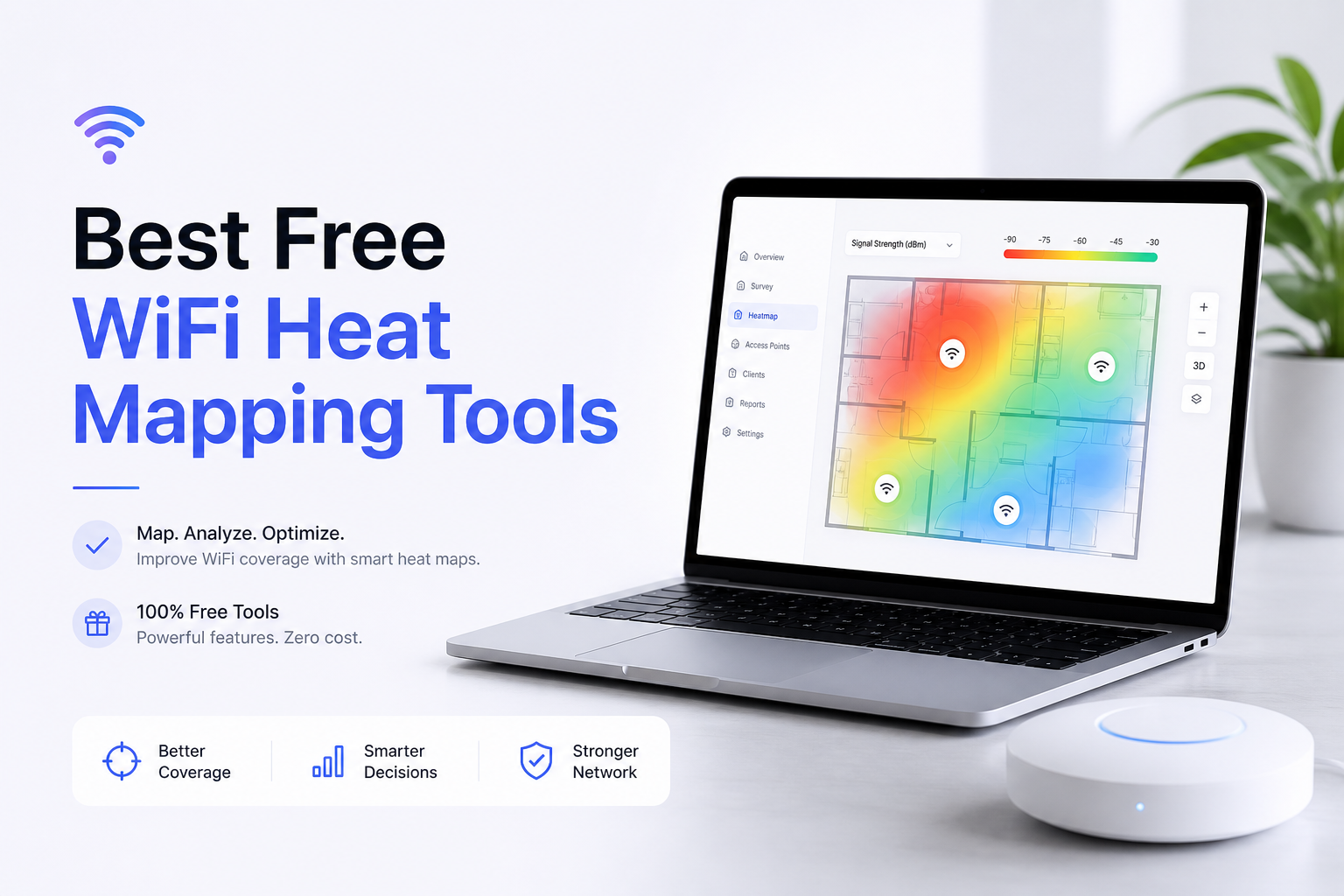
NetSpot is the best overall starting point due to its approachable interface, wide platform support, plus stronger upgrade path. Its free desktop edition mainly handles inspection, though, so choose WiFiman for a genuinely free mobile walkthrough or Hamina for free predictive planning.
NetSpot
9.0/10Best for: Home users who want one interface for WiFi inspection, floor-plan surveys, plus eventual access to deeper paid analysis
- Free desktop WiFi inspector for nearby network analysis
- Apps available for Windows, macOS, Android, plus iOS
- Clear upgrade path from scanning to measured surveys
- Desktop product supports imported floor plans
WiFiman
8.6/10Best for: UniFi households using a compatible LiDAR-equipped phone for a fast room-by-room coverage check
- Completely free mobile download
- Automatic floor-plan capture on supported devices
- Real-time signal monitoring during a walkthrough
- Includes speed plus latency testing
Hamina Network Planner
8.4/10Best for: Network learners or small-site planners modeling no more than three access points before installation
- Free predictive design with no survey hardware
- Supports custom wall attenuation
- Up to three simulated access points
- Downlink coverage heatmaps included
Free WiFi Heat Mapping Tools Compared
These tools are compared by whether they measure an installed network or create a predictive model before installation. The scores reflect free-plan usefulness, setup friction, platform reach, plus limitations rather than laboratory RF accuracy.
| Tool | Measured Survey | Predictive Planning | Price | Score |
|---|---|---|---|---|
| 1. NetSpot PICK | ● No | ● No | Free | 9.0/10 |
| 2. WiFiman | ● Yes | ● No | Free | 8.6/10 |
| 3. Hamina Network Planner | ● No | ● Yes | Free | 8.4/10 |
| 4. UniFi Design Center | ● No | ● Yes | Free | 8.1/10 |
| 5. Cambium Wi-Fi Designer | ● No | ● Yes | Free | 7.7/10 |
The 5 Best Free WiFi Heat Mapping Tools, Reviewed
01 NetSpot
Windows, macOS, Android, iOS · Etwok
9.0/10
NetSpot
Windows, macOS, Android, iOS · Etwok
NetSpot is the most balanced starting point here. The free desktop edition scans nearby networks, shows channels plus signal levels, while its heatmap functions are available as demos. That distinction matters. A continuing measured desktop survey requires Home or a higher edition.
The wider toolset is the reason it still ranks first. NetSpot runs on four major platforms, while the paid desktop editions build on the same interface with actual floor-plan surveys. Home supports 2 zones, 2 snapshots per zone, 50 points per snapshot, plus three core heatmaps.
Download the free edition if you first need to diagnose channel crowding or understand the workflow. Do not mistake it for unlimited free heat mapping. For a single no-cost map, WiFiman may suit you better if your phone plus network meet its requirements.
Best forHome users who want one interface for WiFi inspection, floor-plan surveys, plus eventual access to deeper paid analysis
- Free desktop WiFi inspector for nearby network analysis
- Apps available for Windows, macOS, Android, plus iOS
- Clear upgrade path from scanning to measured surveys
- Desktop product supports imported floor plans
- Useful mix of signal, SNR, plus interference views in paid Home
- Free desktop heatmaps are demos, not unrestricted surveys
- Report export is reserved for higher editions
- Platform features differ, especially on iOS

02 WiFiman
iOS, Android · Ubiquiti
8.6/10
WiFiman
iOS, Android · Ubiquiti
WiFiman offers the simplest route from phone to visual coverage map. Its mobile Floorplan Mapper records signal strength as you walk, so there is no need to click dozens of points on an imported drawing.
The catch is hardware dependence. Ubiquiti specifies a LiDAR-equipped mobile device for Floorplan Mapper, while richer signal, throughput, latency, plus roaming details require a UniFi Cloud Gateway. The desktop app does not include the mobile mapping features.
This is a strong choice for checking a living room, hallway, or small office after moving a mesh node. It is less suitable for formal survey documentation or vendor-neutral predictive planning.
Best forUniFi households using a compatible LiDAR-equipped phone for a fast room-by-room coverage check
- Completely free mobile download
- Automatic floor-plan capture on supported devices
- Real-time signal monitoring during a walkthrough
- Includes speed plus latency testing
- Very little setup for compatible UniFi homes
- Floorplan Mapper requires supported LiDAR hardware
- Several connection metrics require a UniFi Gateway
- No desktop heat-mapping workflow
03 Hamina Network Planner
Web app · Hamina Wireless
8.4/10
Hamina Network Planner
Web app · Hamina Wireless
Hamina is a predictive planner rather than a walk-through survey app. Upload a floor plan, scale it, draw walls or other attenuating objects, then place virtual access points to estimate downlink coverage.
The free account is unusually useful for learning RF design. It permits 3 simulated APs, 5 AI wall-drawing runs, downlink heatmaps, plus customizable wall height or attenuation. That is enough for an apartment, house, café, or very small office.
There is no measured WiFi survey in the free plan. PDF export, uplink heatmaps, automatic AP placement, plus unlimited access points also require paid products. Treat its output as a planning model, then validate the installation with real measurements.
Best forNetwork learners or small-site planners modeling no more than three access points before installation
- Free predictive design with no survey hardware
- Supports custom wall attenuation
- Up to three simulated access points
- Downlink coverage heatmaps included
- Works through a browser
- No measured site surveys in the free account
- Three-AP ceiling limits larger projects
- Free reports cannot be exported to PDF
04 UniFi Design Center
Web app · Ubiquiti
8.1/10
UniFi Design Center
Web app · Ubiquiti
UniFi Design Center turns an uploaded floor plan into a predictive deployment model. You can draw attenuation objects, place UniFi access points, compare primary or overlapping coverage, then review a data-rate heatmap.
A July 2026 update added automatic AP placement plus automatic channel planning. Those features save time during early drafts, particularly if you have not settled on access-point count or radio placement.
The tool is license-free, yet it is tied closely to Ubiquiti hardware. Its maps predict coverage rather than measure the live RF environment. They will not reveal a neighbor's overlapping channel, a noisy microwave, or poor client behavior.
Best forBuyers designing a new UniFi installation who want coverage estimates plus a matching equipment layout
- License-free browser access
- Automatic access-point placement
- Automatic channel planning
- Customizable walls plus attenuation objects
- Useful 2D, 3D, coverage, plus data-rate views
- Centered on UniFi hardware
- Predictive output is not a post-install survey
- Requires careful floor-plan scaling for useful estimates
05 Cambium Wi-Fi Designer
Web app · Cambium Networks
7.7/10
Cambium Wi-Fi Designer
Web app · Cambium Networks
Cambium Wi-Fi Designer keeps the process basic: upload a floor plan, scale it, add access points, then inspect predicted RF coverage. A guest mode lets you explore before creating an account.
The service is free to use. Registered users can save projects or email a completed heatmap with a bill of materials. It also provides a built-in drawing option if no floor-plan image is available.
Its main weakness is scope. This is a design aid for Cambium deployments, not a live signal survey. The interface feels more utilitarian than Hamina or the newer UniFi Design Center, though that simplicity can help on a quick quote.
Best forInstallers drafting a Cambium-based network who need a free heatmap plus bill of materials
- Free cloud-based planning tool
- Guest demo available
- Built-in floor-plan drawing
- Saved heatmaps for registered users
- Can produce a bill of materials
- Predictive maps only
- Best suited to Cambium access points
- Fewer advanced analysis options than professional planners
How We Evaluated These Free WiFi Heat Mapping Tools
We compared the current free-plan limits shown in each maker's documentation as of July 2026. Scoring focused on whether the tool creates measured or predictive maps, floor-plan handling, device restrictions, platform access, export limits, plus how quickly a home user could reach a useful result.
Scores are editorial rather than controlled RF benchmarks. Predictive coverage cannot be fairly benchmarked against a walkthrough survey because the two methods answer different questions.
How to Choose a Free WiFi Heat Mapping Tool for Your Space
Start by deciding whether you need to map an existing network or plan a new one. For an installed network, use measured readings from WiFiman or a paid NetSpot survey. For access-point placement before installation, choose Hamina, UniFi Design Center, or Cambium Wi-Fi Designer.
Also check the hidden requirements. Mobile mapping may need LiDAR or matching network hardware. Browser planners may support only one vendor. A free desktop download may scan channels without letting you complete a reusable heatmap.
Common Free WiFi Heat Mapping Mistakes to Avoid
Do not judge WiFi from color alone. A green signal map can still hide channel contention, low SNR, packet loss, bad roaming, or a slow wired uplink. Keep the same phone or laptop throughout a survey since different radios report signal levels differently.
For predictive maps, scale the floor plan before placing access points. Mark concrete, brick, tile, metal shelving, plus elevator shafts realistically. A rough wall model can produce a polished map that has little connection to the finished space.
Which Free WiFi Heat Mapping Tool Should You Pick?
NetSpot earns first place because it is the easiest broad starting point for inspecting WiFi now, then moving into proper surveys later. Its free heatmaps are demos, so WiFiman is the better zero-cost choice for a compatible mobile walkthrough. Pick Hamina, UniFi Design Center, or Cambium Wi-Fi Designer when you need to model access-point placement before buying hardware.Use a predictive planner before installation, then verify the finished network with measurements taken from the devices people actually use.