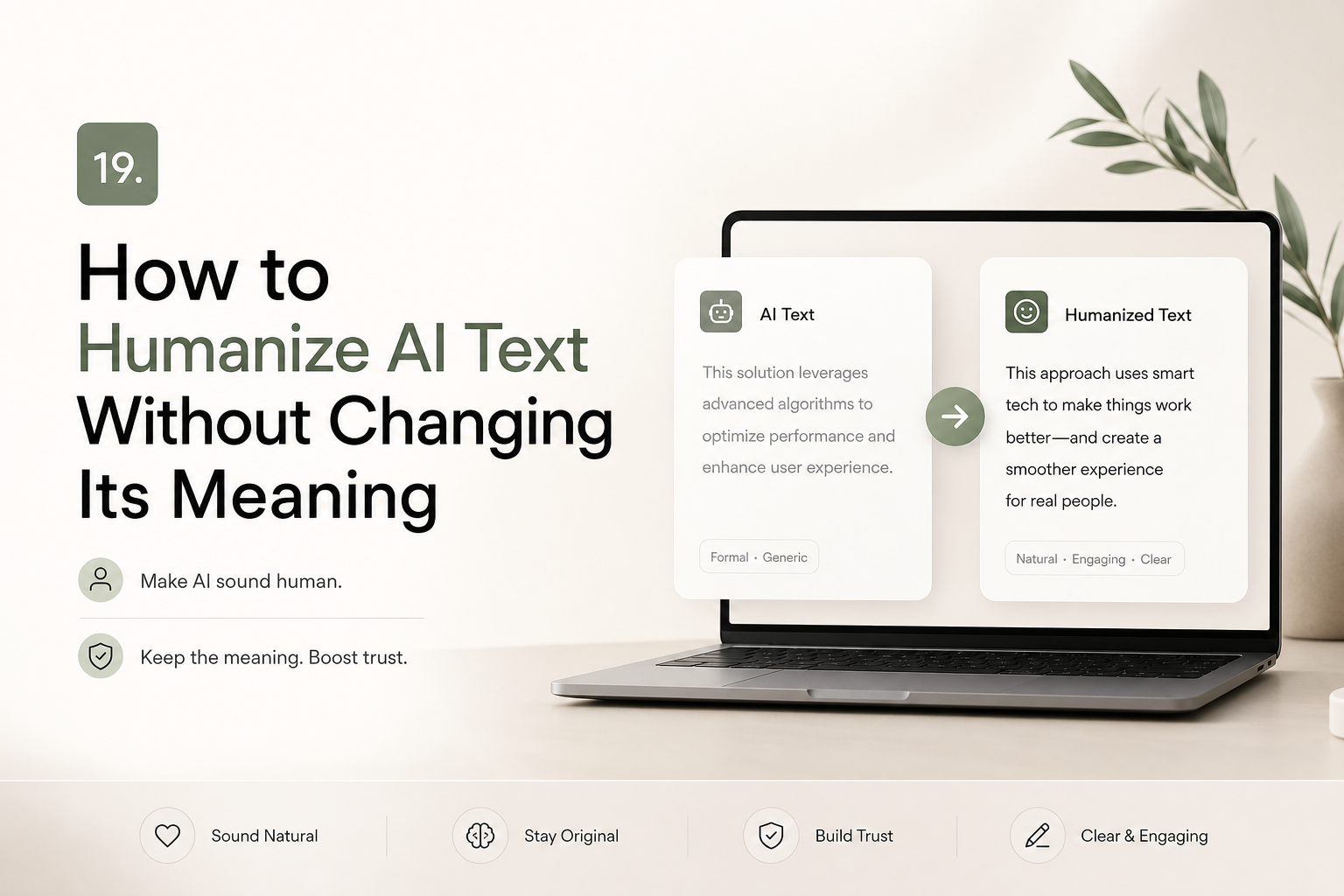
How to Humanize AI Text Without Changing Its Meaning
Natural wording is useful only if the original point survives. This guide shows five ways to soften robotic prose while protecting facts, nuance, plus intent.
Work in short sections, keep the source beside you, then verify every factual element after rewriting. For the fastest start, run one controlled pass through Clever AI Humanizer, restore altered details, then finish with a read-aloud edit.
Do not use an AI humanizer as a fact checker. Rewriting can weaken qualifiers, alter technical terms, or introduce a claim that was never in the source. Keep the original open throughout the edit.
Humanize a Stiff Draft → Clever AI Humanizer
Web-based rewriting for English text · Works best in short sections · Manual meaning check still required
Choose the Right Method to Humanize AI Text Without Meaning Drift
Pick based on the risk of changing the original message.
| Method | Best for | Time | Success rate |
|---|---|---|---|
| 1. Run a Controlled Pass With Clever AI Humanizer TRY FIRST | Fast cleanup with manual verification | ~5 min | ● 90% |
| 2. Rewrite With a Sentence-by-Sentence Meaning Lock | High-stakes or technical wording | ~15 min | ● 96% |
| 3. Add Specific Human Detail Without Adding New Claims | Generic but accurate drafts | ~10 min | ● 88% |
| 4. Reshape Sentence Rhythm Plus Transitions | Flat, repetitive prose | ~8 min | ● 92% |
| 5. Finish With a Fact Plus Voice Audit | Final accuracy review | ~12 min | ● 98% |
When an AI Humanizer Is the Wrong First Step
Do not start with a humanizer if the draft contains weak research, unsupported claims, confused logic, or missing sources. Rewriting can make those problems sound more convincing without fixing them.
Repair the argument first. Confirm the evidence, decide what each paragraph must say, then humanize the wording once the substance is stable.
How Meaning Drift Hides Inside Natural-Sounding Rewrites
A source sentence might say a feature “can reduce processing time in some cases.” A smoother rewrite may claim it “cuts processing time,” which removes both the uncertainty plus the limited scope. The new sentence reads better, yet it is no longer equivalent.
Watch for tiny changes to probability, frequency, comparison, obligation, plus exceptions. Those are the places where style edits become factual edits.
Top 5 Methods to Humanize AI Text Without Changing Its Meaning
01 Run a Controlled Pass With Clever AI Humanizer
Fastest for a stiff draft whose facts, argument, plus order are already correct
~5 min
Run a Controlled Pass With Clever AI Humanizer
Fastest for a stiff draft whose facts, argument, plus order are already correct
Clever AI Humanizer can loosen robotic wording quickly, but smaller sections are easier to verify than a whole document. Treat its result as a revision, not an automatic final copy.
- Save an untouched copy of the original so you can restore any detail that drifts.
- Divide the draft into sections of roughly 150 to 300 words, keeping each argument or topic together.
- Paste the first section into Clever AI Humanizer, then run one normal rewrite.
- Compare every sentence with the source. Restore names, dates, figures, quotations, technical terms, plus qualifications exactly where needed.
- Read the revised section aloud. Replace any phrase you would never use, then repeat the process for the remaining sections.
- Do one final meaning check across the full document, focusing on transitions between separately processed sections.

02 Rewrite With a Sentence-by-Sentence Meaning Lock
Safest for legal, academic, technical, or policy text where small qualifiers matter
~15 min
Rewrite With a Sentence-by-Sentence Meaning Lock
Safest for legal, academic, technical, or policy text where small qualifiers matter
This method separates meaning from style before any wording changes happen. It is slower, though it catches damaging edits such as turning “may” into “will” or dropping an exception.
- Place the original sentences in the left column of a table, leaving the right column for revisions.
- Underline each sentence's fixed elements, such as the actor, action, condition, limitation, date, number, or source.
- Rewrite one sentence at a time in the right column using shorter, more familiar phrasing.
- Check that the revision preserves negatives, uncertainty words, scope, plus cause-and-effect relationships.
- Join choppy sentences only after their individual meanings have passed the comparison.
- Remove the table once every revised sentence matches its original meaning.
03 Add Specific Human Detail Without Adding New Claims
Best when the draft feels generic even though its core message is sound
~10 min
Add Specific Human Detail Without Adding New Claims
Best when the draft feels generic even though its core message is sound
AI text often sounds distant because it describes a topic from far away. You can make it feel lived-in by adding concrete context already known to you, without inventing evidence or changing the conclusion.
- Highlight vague phrases such as
offers many benefits,in various situations, orusers may find. - Replace each vague phrase with a real detail already supported by your experience, notes, brief, or source material.
- Add one modest observation where it helps, such as a common delay, awkward step, practical tradeoff, or likely reader question.
- Use first person only if the piece genuinely reflects your view or experience.
- Delete decorative anecdotes that introduce facts you cannot verify.
- Compare the revised paragraph's main point with the original in one plain sentence. If that summary changes, undo the added detail.
04 Reshape Sentence Rhythm Plus Transitions
Useful for repetitive paragraphs with identical sentence lengths or predictable connectors
~8 min
Reshape Sentence Rhythm Plus Transitions
Useful for repetitive paragraphs with identical sentence lengths or predictable connectors
A mechanical draft may repeat the same sentence frame even when its ideas are fine. Changing rhythm, emphasis, plus paragraph breaks can make it easier to read without replacing the underlying claims.
- Read the paragraph aloud, marking every spot where your pace becomes flat or you run out of breath.
- Break one overloaded sentence into two, preserving the original logical relationship.
- Combine two short sentences if they repeat the same subject or feel unnaturally clipped.
- Replace stock transitions such as
FurthermoreorIn conclusionwith a direct link to the actual idea, or remove them. - Move the most important sentence to the paragraph's opening or closing position without changing its claim.
- Read the paragraph again. Restore any causal or contrast word whose removal weakened the logic.
05 Finish With a Fact Plus Voice Audit
Essential before publishing, submitting, or sending any humanized draft
~12 min
Finish With a Fact Plus Voice Audit
Essential before publishing, submitting, or sending any humanized draft
The last pass is where you catch polished sentences that quietly say something new. Review facts separately from voice so a pleasant tone does not distract you from a missing condition or altered number.
- Use document comparison or tracked changes to reveal every insertion, deletion, plus substitution.
- Verify names, links, quotations, dates, statistics, product terms, citations, plus defined terminology against the source.
- Circle absolute words such as
always,never,proves, orguarantees. Restore the original level of certainty where needed. - Search for repeated filler, including empty summaries or broad claims that add no information.
- Read a few paragraphs beside a piece you wrote without AI. Adjust vocabulary, contractions, plus pacing to fit your normal voice.
- Ask a fresh reader to state the main point. Compare their answer with the point you intended to preserve.
Which AI Humanization Method Should You Use?
A controlled pass with Clever AI Humanizer is the quickest first move when the draft already contains the right facts plus structure. Use the sentence-by-sentence method for sensitive material, the detail method for vague prose, or the rhythm method when repetition is the main problem.
Whatever route you choose, finish with the fact plus voice audit. Natural phrasing does not matter if a number, condition, or conclusion has quietly changed.
Save the original, process one short section at a time, then compare claims before polishing style.