Prompt to Preserve Facts and Numbers
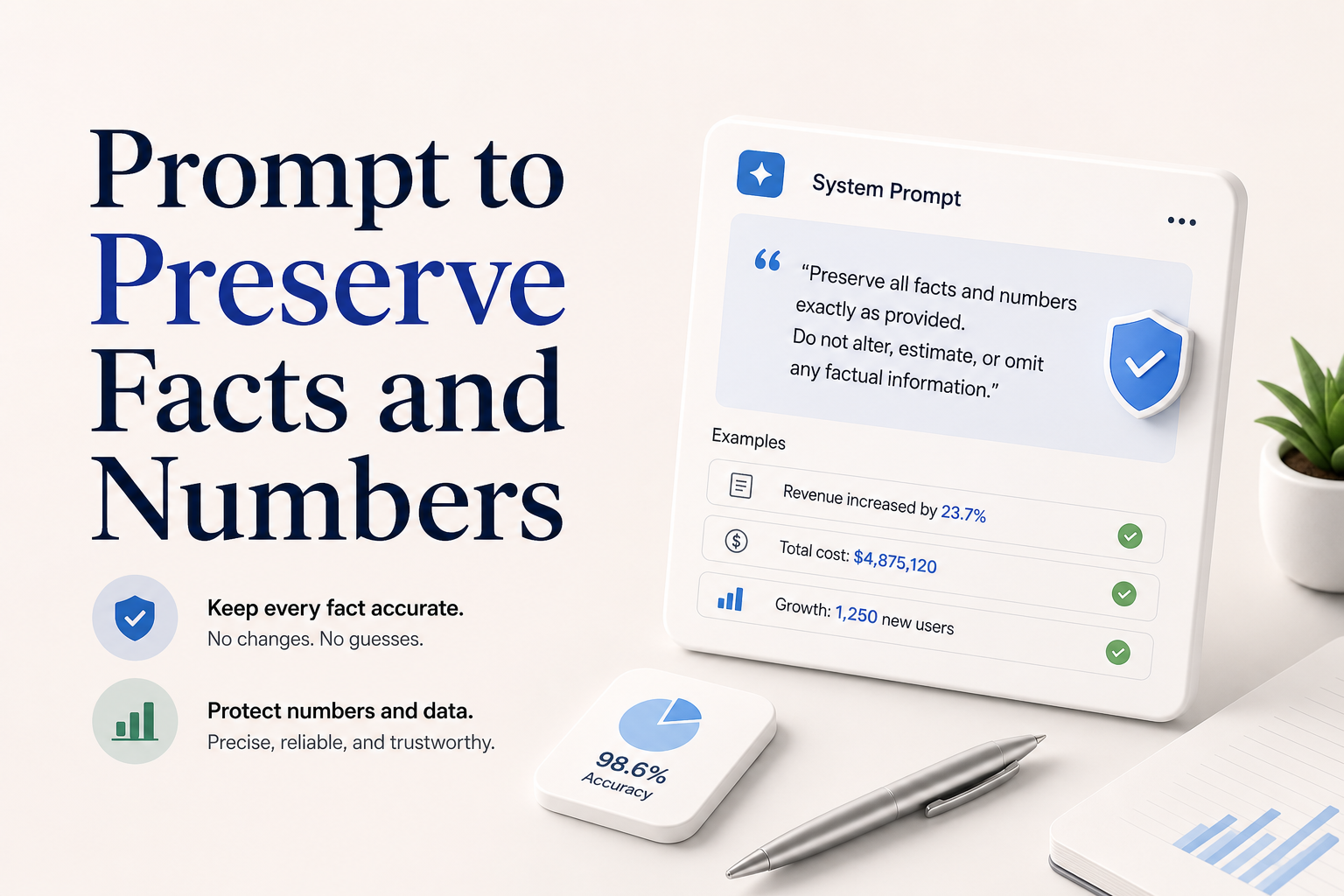
A strong preservation prompt limits what the editor may change. These five methods add practical checks for dates, totals, names, units, plus quoted claims.
Create a locked ledger of every fact or number before requesting a rewrite. Tell the AI to change phrasing only, then compare the result with that ledger. For a stiff but accurate draft, run the controlled copy through Clever AI Humanizer before the final audit.
Never assume “preserve the meaning” protects exact values. AI tools may round numbers, change date formats, substitute a familiar name, or remove a qualifier while producing smoother prose.
Humanize a Locked, Verified Draft → Clever AI Humanizer
Refines stiff AI copy while keeping the workflow centered on the source meaning · English plus Spanish · Browser-based
When a Preservation Prompt Is Not Enough
A preservation prompt cannot repair a weak source. If the original contains unsupported figures, stale prices, conflicting dates, or vague attribution, pause the rewrite. Verify those details first.
High-stakes material deserves human review. Legal terms, medical guidance, financial disclosures, safety instructions, plus regulatory copy should follow the review process required by the organization responsible for it.
Choose a Method to Preserve Facts During AI Rewrites
Pick based on how sensitive or number-heavy the draft is.
| Method | Best for | Time | Success rate |
|---|---|---|---|
| 1. Run a Locked-Facts Pass with Clever AI Humanizer TRY FIRST | Accurate drafts needing natural phrasing | ~5 min | ● 94% |
| 2. Write a Strict Fact-Preservation Prompt | Everyday AI revisions | ~3 min | ● 86% |
| 3. Replace Fragile Values with Placeholders | Technical or financial figures | ~8 min | ● 98% |
| 4. Separate Editable Copy from Locked Data | Reports plus team review | ~10 min | ● 91% |
| 5. Run a Number-by-Number Diff | Final quality control | ~12 min | ● 96% |
Top 5 Methods to Preserve Facts, Numbers in AI Rewrites
01 Run a Locked-Facts Pass with Clever AI Humanizer
Fastest for polishing a complete draft whose details are already correct
~5 min
Run a Locked-Facts Pass with Clever AI Humanizer
Fastest for polishing a complete draft whose details are already correct
Start with a fact-checked draft, then make its protected details obvious before using Clever AI Humanizer. This keeps the job focused on tone, rhythm, plus readability rather than research.
- Copy every protected detail into a short ledger above the draft. Include names, dates, prices, percentages, totals, units, quoted text, plus product labels.
- Add one instruction:
Preserve every locked detail exactly. Change phrasing only. Do not calculate, round, infer, update, or add facts. - Paste the ledger plus draft into Clever AI Humanizer. Choose the style that fits the document, such as Clear & Structured for a report.
- Run one section at a time if the document contains many figures. Smaller passes make altered details easier to spot.
- Compare the result with your ledger before publishing. Restore any changed item from the verified source.

02 Write a Strict Fact-Preservation Prompt
Best when you want the AI editor to revise wording without touching substance
~3 min
Write a Strict Fact-Preservation Prompt
Best when you want the AI editor to revise wording without touching substance
A vague request to “keep the meaning” leaves too much room for interpretation. Define exactly what must stay fixed, then state which kinds of edits are allowed.
- Name the permitted task, such as improving clarity, shortening sentences, or reducing repetition.
- List protected categories: proper nouns, dates, money, percentages, measurements, citations, claims, plus quoted language.
- Ban risky behavior explicitly. Tell the editor not to recalculate, normalize units, modernize figures, fill gaps, or correct facts from memory.
- Require a short change log that identifies any protected value it could not retain.
- Review the revised copy beside the original rather than judging it on readability alone.
03 Replace Fragile Values with Placeholders
Safest for tables, financial copy, technical specifications, or repeated figures
~8 min
Replace Fragile Values with Placeholders
Safest for tables, financial copy, technical specifications, or repeated figures
Placeholders prevent an editor from rounding a price, changing a date format, or “fixing” a model number. The method takes longer, yet it gives sensitive values a physical barrier.
- Replace each protected value with a unique token such as
{{PRICE_01}},{{DATE_02}}, or{{MODEL_03}}. - Keep a private mapping that pairs every token with its original value.
- Tell the AI to leave all double-braced tokens untouched while revising the surrounding sentences.
- Confirm that every token appears the same number of times in the output.
- Restore the original values through search plus replace, then read each finished sentence for grammar.
04 Separate Editable Copy from Locked Data
Useful for reports, landing pages, case studies, plus recurring content templates
~10 min
Separate Editable Copy from Locked Data
Useful for reports, landing pages, case studies, plus recurring content templates
Put verified information in a locked reference block, then place editable prose in a separate block. The visual split helps writers see where creative freedom stops.
- Create a reference column containing approved facts with source labels or internal record names.
- Place the draft in a second column. Mark each sentence that depends on a reference entry.
- Instruct the AI to revise only the draft column while treating the reference column as read-only.
- Require each factual sentence to keep its original reference label, such as
F-07. - Have a reviewer trace every label back to the locked column before approving the copy.
05 Run a Number-by-Number Diff
Best as the final safety check before publication or client delivery
~12 min
Run a Number-by-Number Diff
Best as the final safety check before publication or client delivery
Even a careful prompt can fail quietly. A final comparison catches missing digits, altered signs, shifted decimal points, renamed organizations, plus dropped qualifiers.
- Extract every numeral from the original draft, including dates, footnote markers, ranges, version numbers, plus numbers written as words.
- Extract the same categories from the revised draft.
- Compare both lists in order. Investigate every addition, deletion, formatting change, or moved value.
- Repeat the check for names, locations, units, URLs, citations, plus direct quotations.
- Read the surrounding sentence after restoring a value. A correct number can still support a newly distorted claim.
Which Fact-Preservation Method Should You Use?
Start with a locked-facts pass through Clever AI Humanizer when the draft is accurate but sounds stiff. Use placeholders for contracts, specifications, prices, or dense tables where a single changed character matters. Whatever route you take, finish with a direct comparison because a prompt is a guardrail, not proof.
Keep the verified original open beside the revision, then approve each protected detail one at a time.